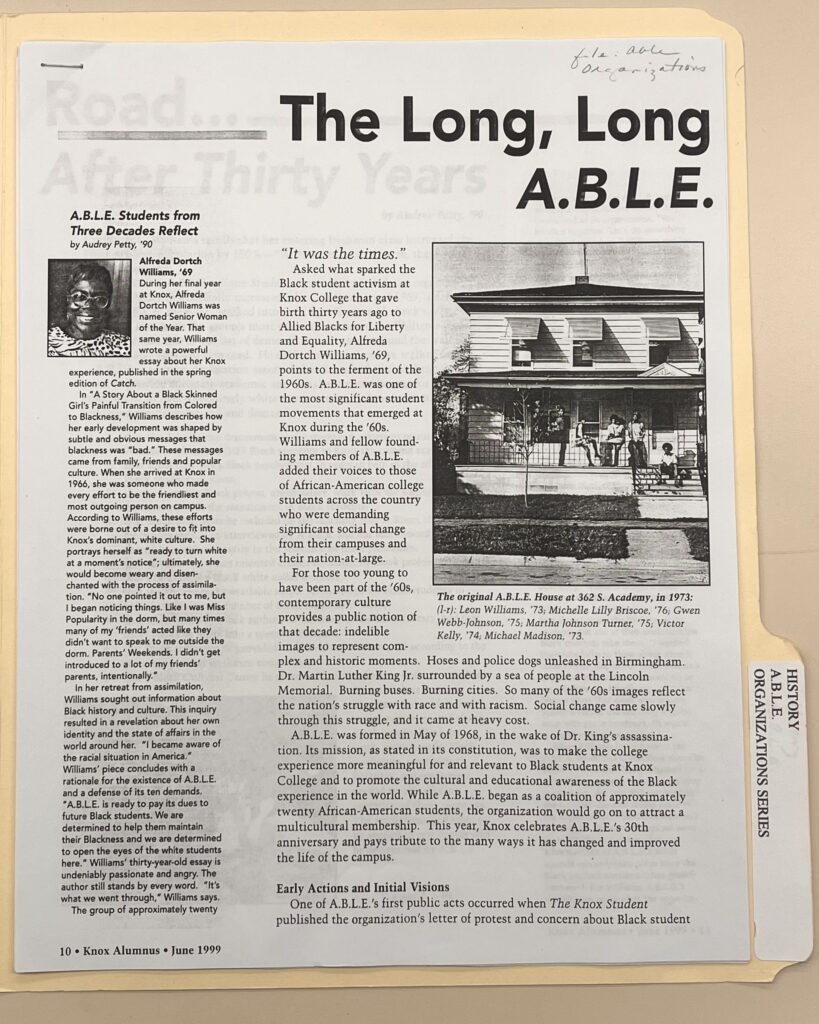
Pictured is an article in the “Knox Alumnus” published June 1999 titled, “The Long, Long, A.B.L.E.: A.B.L.E. Students from Three Decades Reflect” by Audrey Petty, ’90.
We listened to excerpts from an interview of Alfreda Dortch Williams, a Knox alum and one of the founders of ABLE. The interview was done by our very own Joseph Taylor and transcribed by Kamana’okekai Lattig. In the interview, she discusses various topics such as her early life, family, education in the north and south of the United States, and various experiences she had as a Black woman in the 1960s. She is an important figure in Knox’s history because, as stated, she was involved in the founding of Allied Blacks for Liberty and Equality, or A.B.L.E.”
What I found most interesting was her recollection of the dissonance encountered during the creation of ABLE. What I find most interesting about activists is their ability to create a sense of unity and belonging within a group to avoid in-fighting and focus attention back to the issue at hand. Dortch reads a letter written to ABLE members. In this letter, there are lines such as, “Our model should be unity. We must be unified in order to survive as a group” [R3 / Excerpt 7: 23:30 – 27:13]. After this reminder, the writer comments on the distraction ABLE members faced at the time, then reassures that differences within group members is normal and expected. I would imagine this letter being very effective for the actions of ABLE members, because they went on to do amazing things later on.
Something that I noticed was her usage of the term “uppity”. This is a word I avoid using now, as it has a negative racial connotation. The history of the word, to my knowledge, is that it was a term used against Black people to belittle them for their intellect or their perceived confidence in themselves. You call a Black person “uppity” to put them in their “place”, which is below White people, no matter how “smart” or sure of themselves they seemed. “Uppity” Black people would often get lynched the most during the 1800s. For example, teachers, leaders, people who spoke against racism and oppression would be targeted by lynch mobs and the KKK. I do not believe Dortch uses it in this way, obviously, as I’m sure the language of the time was simply engrained into her vocabulary, something very understandable when discussing such topics. However, it speaks to how language of the past differs from today after collectively learning from history.
Throughout the Black Arts Era, from 1960 to 1975, we hear of amazing figures such as Malcolm X, MLK Jr, Amiri Baraka, June Jordan, Edridge Cleaver, and more. Usually, these activists and artists are deceased and we are reading from their history. It is a nice change of pace whenever reading from someone presently living to discuss these experiences in a space that is more accepting of them. It also reminds us that these times were not at all as long ago as people like to think.
Great work, Charlene. You’re comment about studying the words of someone living is spot on. There’s a real sense of connection there. I also appreciate your analysis of the historical use of language. Lastly, wouldn’t it be a great addition to this project to find the essay Alfreda published in the Spring 1969 issue of Catch? (I might have copies in my office. But the library will also have them.)